

Damming the Bering Strait
Pushing a landscape approach to its limits

There’s another strait closure to worry about.
Two weeks ago, the New York Times published an article with the headline ‘A New Idea to Save the Climate? Dam the Bering Strait.’ It’s a short, restrained article. So short and restrained, in fact, that you might miss that this would be one of the single largest and most consequential engineering projects—and landscape projects—ever undertaken.
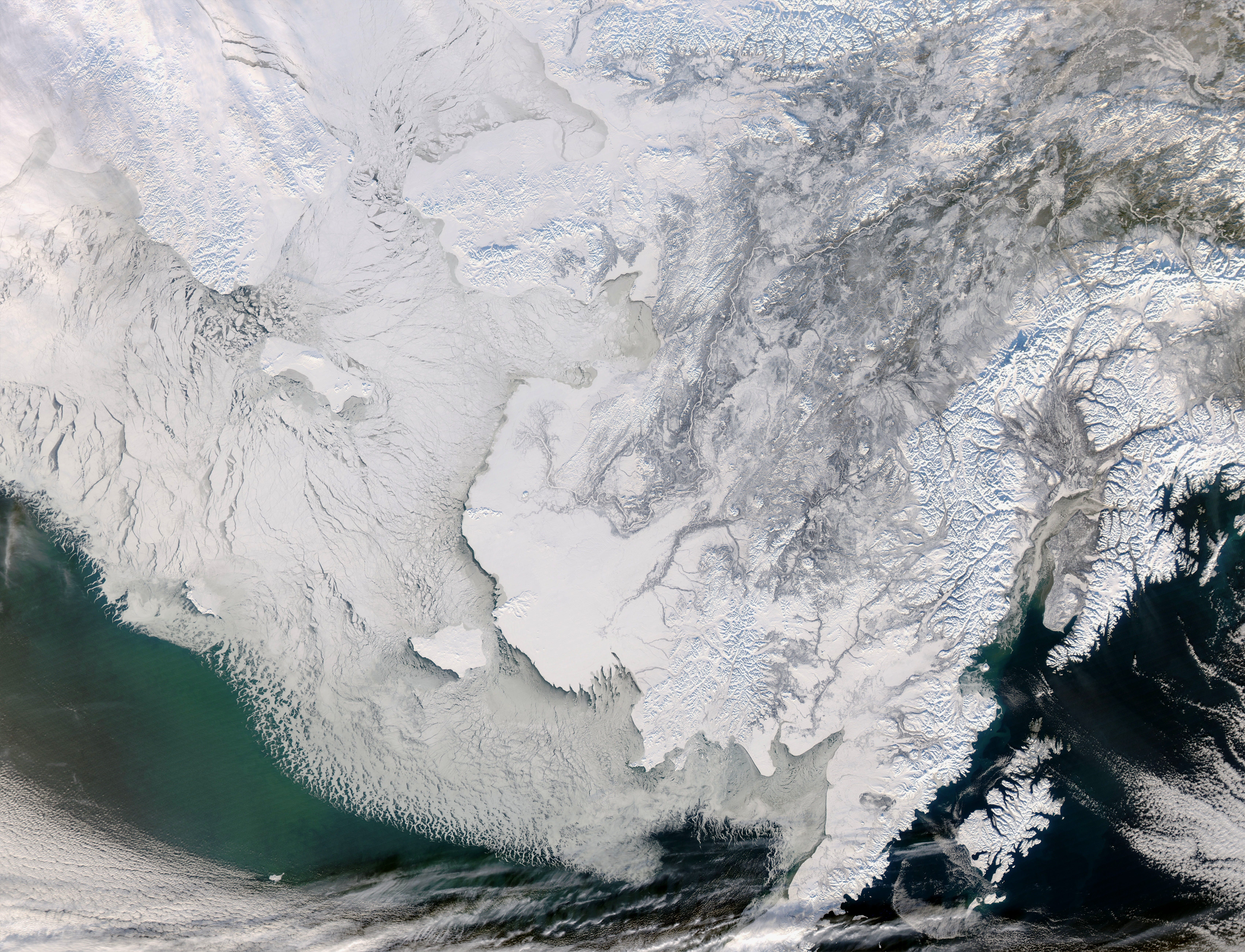
Discussions about climate have become fixated with ‘points’: tipping points, chokepoints, leverage points, inflection points, intersection points, points of failure and points of potential salvation. For climate repair, intervening at a point where impact would be greatly magnified makes sense—it is the impetus for everything from methane removal to the dubious planetary sunshade idea.1 But ‘systems thinking,’ out of which this glorification of ‘points’ is born, can drag us up and away from the physical environment. To paraphrase an old saying, the system is not the territory.
I’ll begin this post by discussing the AMOC, or Atlantic Meridional Overturning Circulation, the ‘problem’ that a Bering Dam would address. Then, I’ll go over how the role that the Bering Strait itself might play in this proposal, and what proposals might follow.
The AMOC Problem
The occasion for the Times article was the publication that same day of a scientific paper called ‘The effects of a constructed closure of the Bering Strait on AMOC tipping behavior,’ published in Science Advances.2 The authors, Jelle Soons and Henk Dijkstra, are researchers at the University of Utrecht’s Institute for Marine and Atmospheric research (IMAU), where they primarily study a system of ocean currents called the AMOC.
The AMOC is responsible for pulling warm water to Europe’s western coasts (among many other things). Its potential to slow down, or even hit a ‘tipping point’ into collapse, because of climate change has become a key focus of debate among oceanographers and climate scientists over the last decade. That debate has only intensified over the past few years as these negative outcomes have appeared, in some studies, to be more likely (and as those conclusions are litigated in the mainstream press and within governments).
Carbon Brief recently published an excellent set of explainers and animated diagrams on the AMOC problem, and I will refer you to them for detail. What’s important to emphasise here, I think, is that the risks of AMOC slow-down and collapse run counter to popular (i.e., intuitive!) conceptions of climate change impacts.
For example, you still often hear about England’s ‘win’ in acquiring a progressively warmer climate, one which supports the cultivation of high-quality wine grapes. In fact, however, England owes much of its high-latitude warmth to AMOC. Another IMAU study projected that an AMOC slow-down could see extreme winter temperatures in London reach -20°C (-4°F), far lower than the current record. Another influential research group, the Global Systems Institute at the University of Exeter, estimates that three-quarters of arable land in England would become unusable under such conditions.
Hence this radical proposal. Closing the Bering Strait would prevent the transfer of relatively fresh water from the Pacific to the Atlantic, and, because the AMOC depends on water entering the North Atlantic with a high salt content, this closure could preserve its stability. The authors are genuinely confident that the closure would ‘work,’ in that it would prevent AMOC collapse even as atmospheric CO₂ continues to build and freshwater rushes out of the Arctic ice: “We expect a reproduction of our experiments with a more detailed model . . . will only affect our results quantitatively”—that is, marginally. This claim is beyond my ability to judge. What I want to look at, instead, is how the idea of a Bering Dam pushes ‘a landscape approach to climate repair’ to its limits.
Arctic Dreams
Both carbon dioxide removal techniques and solar radiation management can be effective tools to limit global warming and prevent an AMOC collapse, but their deployment comes with considerable technical, economical, and governance considerations. We here propose as an intervention the construction of a Bering Strait Dam (BSD). The BSD would disconnect the Pacific Ocean from the Arctic Ocean with three separate dams. It consists of a western section connecting mainland Russia to Big Diomede Island, a middle section connecting the Diomede Islands, and an eastern section connecting Little Diomede Island to Alaska, USA. Combined, these sections have a length of roughly 80 km and encounter an average depth of 50 m with a maximum depth of 59 m. Given these dimensions, the construction of the BSD is considered to be technically feasible . . .
The results presented here indicate that an artificial CBS [Closure of the Bering Strait] could be an effective climate intervention strategy to prevent an AMOC collapse under CO₂ forcing.
Jelle Soons and Henk Dijkstra, in their paper
A dam across the Bering Strait... Isn't it just a flight of fancy?
Boris Lyubimov in Literaturnaya Gazeta, 1959
I wrote in my last post that climate repair is about designing the atmosphere through the ground. Most of the time, this fact is elided or downplayed—most ‘climate solutions,’ and most technologies in general, are imagined in isolation from the landscapes and histories they become part of.3 But not in this case.
Though the Bering Strait was somewhat unceremoniously excluded from a recent survey of global trade chokepoints, one area where its importance is not questioned is pre-history. Not only did ‘Beringia,’ commonly known as the ‘Bering land bridge,’ spawn novel ecosystems and ferry humans across to North America, its rise and fall also triggered ‘violent temperature swings.’
Even before these swings were understood, scientists had guessed that the Bering Strait possessed a unique kind of control over the climate system. This took precedence even over its potential role in global trade. Soviet engineers first floated the idea of a dam in the late 50’s, with the aim of causing global warming to make Siberia, Alaska, and Canada more suitable for agriculture. Soviet journalists reached for very direct (and, in hindsight, premature) metaphors to connect the idea of geoengineering with a USA-USSR rapprochement: “Ice floes of the ‘cold war’ are cracking,” one wrote in 1959; “What mankind needs is war against cold, rather than a ʻcold war,ʼ” wrote another.4 In this case, diplomatic climates and atmospheric climates were seen as tied to specific leverage points and ‘contact zones’ within the land and ocean. An Iron Curtain at one extreme, a Concrete Blanket at the other.
Just because a landscape is given some consideration alongside the atmosphere, however, does not guarantee a project’s success. “In a region like the Arctic,” the writer Barry Lopez warns, “tense with a hunger for wealth, with fears of plunder, interpretation can quickly get beyond a scientist’s control.”5 The abstract ‘system’ view is a powerful interpretation, but necessarily falls short of grasping the landscape in its entirety.
Instead of the usual ‘chokepoint,’ Lopez refers to the Bering Strait as a ‘funnel.’ It is a landscape of churn and of concentrated energy. That describes its currents and its undersea oil, yes, but also its storms, ice, intense sunlight, birds, plankton, fish, and megafauna—the most famous of which is the strange looking, ice-breaking bowhead whale. The bowhead’s spring migration north through the Strait would be completely prevented by a dam.
The past two hundred years have seem many attempts to ‘steal’ energy from this rich funnel, the environmental historian Bathsheba Demuth writes, echoing Lopez, and each theft ‘makes new worlds’ in the process.6 It’s not hard to read the Soviet proposals, and now this Dutch one, in that same vein. Nor is it hard to see the obvious problem with closing off the Strait: it would create a completely new Bering ‘world,’ one that would be significantly worse for its already-precarious ecology, and for its Indigenous communities. Lopez’s celebrated 1986 book Arctic Dreams: Imagination and Desire in a Northern Landscape ends with a warning about ‘alarming trends’ in the Arctic, and he places the Bering Dam right alongside oil extraction.
So, the dam proposal, in its current form, is probably unworkable. It is too much like the failed proposals of the past. To those who possess the expertise to come up with better ideas (that is, not me), what example could they follow instead?
From Zandmotor to Ijsdijk
In the short press release provided by the University of Utrecht alongside the paper, Jelle Soons compares his and Dijkstra’s proposal to bariatric surgery—one of the common analogies used to make the ‘moral hazard’ argument against geoengineering/climate repair, which I’ve written about at length. This particular analogy might reveal more about Dutch attitudes to that procedure and to obesity than the Bering Dam itself, however. We should look instead to another Dutch peculiarity: their national relationship to watery environments. Traditionally distinguished by three things—dig, ditch, dam—the manipulation of water in the Netherlands has undergone a broad shift in is guiding principles over the past twenty five years from that more aggressive style to one which attempts to ‘work with’ the landscape and its water as ‘allies,’ as documented by the MIT anthropologist Stefan Helmreich.7
For Helmreich as well as Richard Weller, the landscape architect I discussed in the last post, one project in particular typifies this shift: the Zandmotor, or sand-motor. The Zandmotor was constructed in the early 2010’s to stabilise Monster Beach, outside the Hague. Unlike other ‘beach nourishment’ projects, which require regular input of imported sand to keep coastlines stable, the Zandmotor functions by allowing the natural push of waves and wind to distribute sand, forming dunes and preventing further erosion. For Weller, the Zandmotor “marks a new technological and predictive level of human engagement with the environment.” He also praised it as “one of the great artworks of the early Anthropocene.” Would he say the same about a Bering Dam? I’m not so sure that he would.
Next to the dam(s) across the Strait, of course, the Zandmotor would look quaint. The goals, too, are orders of magnitude more grand—the proposal is explicitly cast by Soons and Dijkstra as a ‘climate intervention,’ not merely a hydrological one. Indeed, it would be the largest ever climate intervention, thought its impact would be measured differently to the other methods the researchers mention, carbon dioxide removal and solar radiation management. Rather than capture a diffuse gas like CO₂ bit-by-bit, or dim the sun ‘on average,’ this proposal—like all dams—aims to leverage (as Demuth might say, steal from) physically and geographically-concentrated power. 50 miles of dams, an ice-dyke or Ijsdijk, if you will, would change three oceans at once, and possibly forever. The message of the Zandmotor, Stefan Helmreich says, is “about hope and futurity.”8 The Ijsdijk brings up rather different emotions.
Bottom line: I don’t think there will ever be a dam across the entire Bering Strait. As with all other modern ‘Arctic dreams,’ from the hunt for the Northwest Passage onward, the reality of politics and the reality of the landscape block the path. Jelle Soons and Henk Dijkstra are more aware than their dreaming predecessors that this is so, and their aims are more noble. However, they still rely on tools which produce a “great compression of space and time” but are not able to get a hold on “unsummarised dimensions of a deeper landscape.”9 Barry Lopez was describing the airplanes which whisk politicians to and from Arctic villages on political tours, but the same can be said of climate and oceanographic models. “From the city, one finds it simple to conceive of nothing but a system” writes the Inupiaq poet Joan Naviyuk Kane in a 2015 work called ‘The Straits,’ which could be read as a delayed comment on this situation.10
Those ‘unsummarised dimensions’ of landscape could yet yield a strategy for climate repair efforts at/in/beside the Bering Strait. Many of which can still be explored by scientific means. As with the Zandmotor, working with rather than against the landscape is our best bet. There very well might be, sooner or later, a design that works. Whether this looks like preventing excess freshwater forcing by other means (a smaller dam or barrier? brine addition?), or something else entirely, the importance of this particular funnel-chokepoint should not be underestimated.
If you have any ideas on that front (or have comments, questions, and corrections) do get in touch.
- Will
Whether the sunshade idea should count as ‘repair’ is not clear to me.
The pre-print had been up since August of last year.
Peter Haff’s idea of the ‘technosphere’ attempts to change this.
In my edition of Arctic Dreams, page 114.
Floating Coast: An Environmental History of the Bering Strait, page 313. See also page 5.
In A Book of Waves.
A Book of Waves, page 67.
In my edition of Arctic Dreams, page 256.